
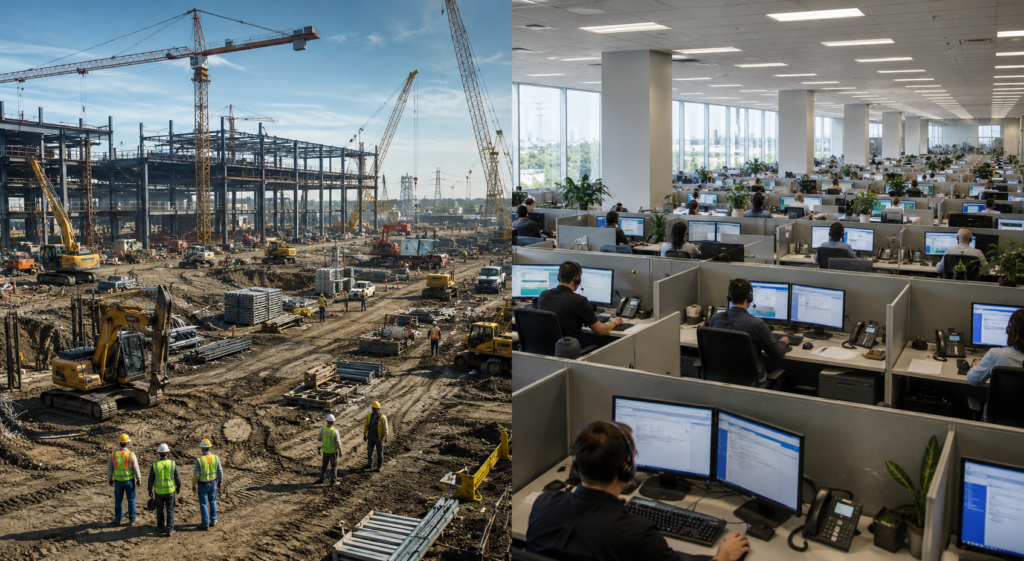
Why Chasing Manufacturing Jobs Is a Slow and Expensive Strategy Compared to Call Centers
For decades, policymakers have treated manufacturing jobs as the gold standard of economic development. New factories are announced with great fanfare, politicians hold ribbon-cutting ceremonies, and communities compete to attract large industrial projects with tax incentives, infrastructure grants, and other forms of public support.
The logic behind these investments is easy to understand. Manufacturing has historically been associated with economic growth, stable employment, and middle-class wages. Factories often become major employers within a region and can serve as anchors for local economies.
However, there is another side to the story that receives far less attention.
Manufacturing is also one of the slowest, most expensive, and most capital-intensive ways to create jobs. Massive amounts of money must be invested before a single worker is hired. Years can pass between a project announcement and the day the facility actually begins operations.
If the goal is simply to create employment opportunities as quickly and efficiently as possible, call centers and similar service-sector operations can often deliver far more jobs for far less money and in a fraction of the time.
This raises an important question: if policymakers are primarily concerned with reducing unemployment and increasing payrolls, are they focusing on the wrong type of job creation strategy?
The Economics of Job Creation
Consider the basic economics.
A typical manufacturing worker earns roughly $45,000 to $60,000 per year. A call center worker earns approximately $40,000 to $50,000 per year.
While manufacturing jobs may pay somewhat more on average, the difference is often relatively modest compared to the enormous difference in startup costs required to create those jobs.
A new manufacturing facility can easily cost $100 million or more to build and may take three years or longer before it becomes operational. Some advanced manufacturing projects require significantly more capital and even longer development timelines.
A call center, by contrast, can often be launched for around $1 million and begin operations within three months.
The contrast is striking.
One model requires years of planning, construction, permitting, equipment installation, and testing. The other primarily requires office space, technology infrastructure, hiring, and training.
When viewed through the lens of cost-per-job and time-to-job, manufacturing often appears far less efficient than many service-sector alternatives.
If the objective is maximizing employment opportunities, the numbers become difficult to ignore.
The Hidden Costs of Manufacturing
Many discussions about manufacturing focus on the jobs created once a facility opens. What is often overlooked are the substantial costs incurred before that point.
Building a factory is rarely a simple construction project.
Manufacturers must identify suitable land, negotiate purchases, obtain permits, complete environmental reviews, install utility connections, coordinate transportation access, and secure specialized equipment.
Many facilities also require substantial investments in electrical capacity, water systems, wastewater management, warehousing, and logistics infrastructure.
These requirements increase both the cost and complexity of every project.
Unexpected delays are also common. Supply chain disruptions, labor shortages, permitting disputes, regulatory reviews, and equipment delivery issues can all extend timelines.
As a result, projects that are expected to take three years may take four years or longer before reaching full production.
During this entire period, the promised jobs largely remain theoretical.
Workers cannot collect paychecks from jobs that do not yet exist.
The Infrastructure Problem
Manufacturing requires land acquisition, environmental reviews, utility upgrades, specialized equipment, transportation infrastructure, supply-chain integration, and extensive construction.
Every step adds cost and delay.
A call center requires office space, telecommunications infrastructure, computers, software systems, and workforce training.
The difference between the two approaches is similar to the difference between building an airport and opening a new office.
One is a massive construction and engineering project.
The other is primarily an operational challenge.
Many communities already possess suitable office buildings that can be converted into call centers with minimal renovation. In some cases, a company can begin hiring workers before all improvements are even complete.
Manufacturing rarely offers that flexibility.
Factories typically require purpose-built facilities designed around specific production processes. They cannot simply move into an empty office park and begin operations next month.
That distinction has enormous implications for economic development strategies.
Time Is Often More Important Than Cost
When communities experience major layoffs, time matters.
A city that loses 3,000 jobs from a plant closure cannot easily tell unemployed workers to wait three years for replacement opportunities.
Families still need income.
Mortgages still need to be paid.
Businesses still need customers.
The faster new employment opportunities appear, the faster local economies can stabilize and recover.
Call centers offer a significant advantage in this regard.
Because startup timelines are measured in months rather than years, communities can begin replacing lost jobs almost immediately.
Even if individual positions pay slightly less than manufacturing jobs, workers may prefer immediate employment to waiting years for future opportunities that may or may not materialize.
A Hypothetical Test Case
To illustrate the point, consider a fictional economic development project.
Scenario A: Manufacturing Plant
- Construction Cost: $100 million
- Construction Time: 36 months
- Jobs Created After Completion: 1,000 workers
This project requires three full years before the first production worker is hired.
For three years, the community waits for the promised economic benefits to arrive.
Scenario B: Call Centers
Assume:
- Cost per Call Center: $1 million
- Construction and Setup Time: 3 months
- Employees per Call Center: 100 workers
With the same $100 million budget, an organization could theoretically build:
- 100 call centers
- 10,000 call center jobs
Even if these assumptions are simplified, the scale difference is remarkable.
The same amount of capital that creates 1,000 manufacturing jobs after three years could potentially create 10,000 service-sector jobs within a single quarter.
The comparison becomes even more striking when time is considered.
What Happens During Those 36 Months?
The manufacturing plant remains under construction for the entire period.
Meanwhile, call centers could be deployed repeatedly and become operational almost immediately.
Month 3
- Manufacturing jobs created: 0
- Call centers operational: 100
- Call center jobs created: 10,000
Workers are already receiving paychecks while the factory site remains a construction zone.
Month 12
- Manufacturing jobs created: 0
- Call center jobs active: 10,000
A full year has passed.
The factory is still not producing goods.
The call centers have already provided twelve months of employment.
Month 24
- Manufacturing jobs created: 0
- Call center jobs active: 10,000
Two years have now passed.
The manufacturing project remains unfinished.
The service-sector jobs continue generating wages and local spending.
Month 36
- Manufacturing plant finally opens
- Manufacturing jobs created: 1,000
- Call center jobs still active: 10,000
Only now does the factory begin delivering on its employment promises.
Under this hypothetical example, call centers create ten times as many direct jobs while delivering those jobs almost immediately instead of requiring a three-year wait.
The Multiplier Effect of Immediate Employment
Employment generates economic activity.
Workers spend money on housing, groceries, transportation, entertainment, healthcare, and local services.
As a result, jobs created today can stimulate economic activity almost immediately.
In the hypothetical scenario above, 10,000 call center workers begin spending money years before the manufacturing facility opens.
That spending supports restaurants, retailers, contractors, landlords, and countless small businesses throughout the community.
The economic impact begins flowing through the local economy almost instantly.
The factory may eventually generate its own economic benefits, but those benefits arrive much later.
The Opportunity Cost
The greatest weakness of large manufacturing projects may be opportunity cost.
Every dollar tied up in a factory is a dollar unavailable for other employment initiatives.
Every year spent waiting for a factory to open is a year during which unemployed workers remain without jobs.
Communities often celebrate future manufacturing jobs while overlooking the fact that alternative investments could begin hiring people within months rather than years.
Policymakers frequently discuss the jobs that a factory will eventually create.
Far less attention is paid to the jobs that could have been created during the years spent waiting for construction to finish.
Opportunity costs are invisible, but they are very real.
Speed Matters
Economic downturns, layoffs, and regional job losses require rapid responses.
A community losing 5,000 jobs today cannot easily wait three to five years for a replacement factory.
Service-sector operations such as call centers can scale quickly, recruit workers rapidly, and begin generating paychecks almost immediately.
From a pure job-creation perspective, speed is often just as important as the total number of jobs eventually produced.
A slower strategy may ultimately create jobs, but a faster strategy can help families and communities much sooner.
For workers facing immediate financial pressures, timing can matter just as much as job quality.
Conclusion
Manufacturing remains important for producing goods, supporting industrial capacity, strengthening supply chains, and advancing national economic objectives. There are legitimate reasons governments may choose to support manufacturing investment.
However, if the primary goal is creating jobs quickly and efficiently, manufacturing projects often represent a slow, expensive, and capital-intensive approach.
A $100 million factory may take three years to create employment opportunities. The same investment directed toward call centers could potentially create thousands of jobs in a matter of months.
While manufacturing may offer strategic advantages, the timeline and capital requirements make it a challenging solution for communities seeking immediate employment growth.
For policymakers focused on employment numbers rather than industrial strategy, the question becomes difficult to avoid: if jobs are needed now, why wait years for a factory when service-sector jobs can be created almost immediately?