
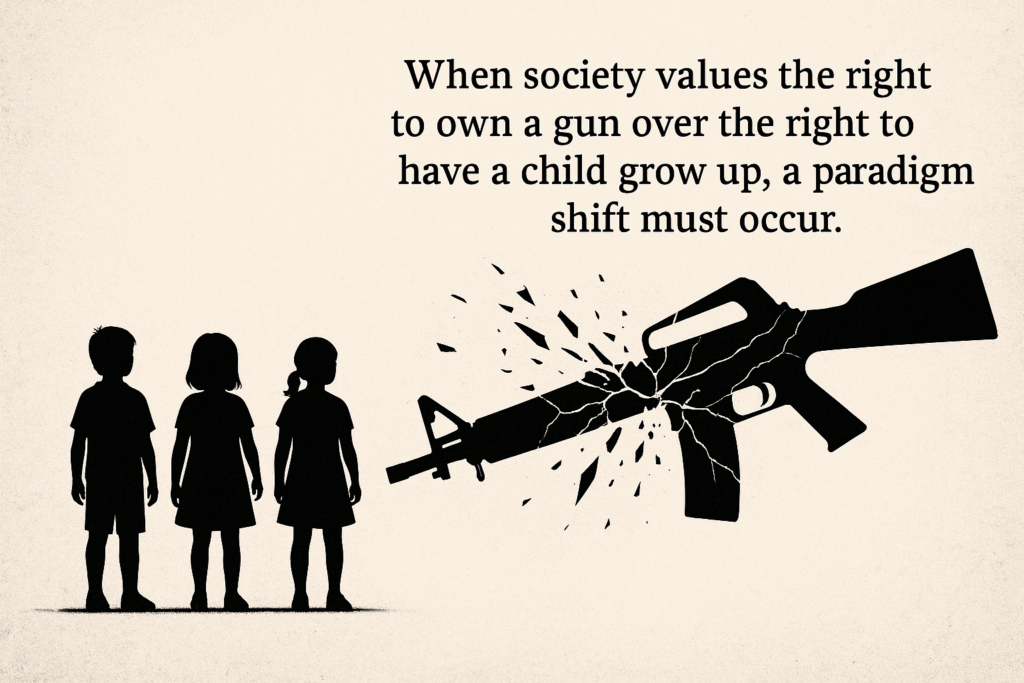
When society values the right to own a gun over the right to have a child grow up, a paradigm shift must occur.
Walk through any American elementary school and you’ll find tiny backpacks hanging in cubbies, crayon drawings on the walls, and too often now laminated “active shooter” instructions taped next to the fire escape plan. Our children practice hiding from bullets the way previous generations practiced duck-and-cover drills or tornado drills.
And still, every time another shooting makes headlines, we’re told that changing gun laws is “too political,” “too soon,” or “an attack on freedom.”
Meanwhile, the body count grows.
Fifty years of preventable funerals
Over the last half-century, the United States has normalized a level of gun violence that would be unthinkable in any other wealthy democracy. Tens of thousands of children and teens have been killed by guns, and many more have been wounded or traumatized just by living in proximity to that violence.
In 2020 alone, firearms killed 10,197 young people ages 0–24 in the U.S. By 2020–2021, guns had become the leading cause of death for children and teens in this country, surpassing car crashes. A Pew analysis found that gun deaths among U.S. children and teens rose 50% in just two years, from 2019 to 2021.
Between 2015 and 2022, at least 29,608 youths across the Americas died from firearm injuries in the U.S. alone. Every year now, nearly 22,000 American children and teens are shot and killed or wounded, and roughly three million are exposed to gun violence in some way hearing gunfire, losing a loved one, surviving a lockdown that was not a drill.
Stretch those yearly numbers out over fifty years, and you’re not looking at statistics; you’re looking at entire towns’ worth of children erased, and entire cities’ worth of children living with scars you can’t see.
And that’s before we even talk about the shootings that have defined the last few decades of American life. Since Columbine in 1999, there have been over 390 school shootings, killing at least 203 and injuring 441 on K–12 campuses alone. Names of schools Columbine, Sandy Hook, Parkland, Uvalde have become shorthand for horror, each one a place where parents sent their kids to class and got a phone call that shattered their universe.
When we say, “gun rights,” this is the bill that gets handed to our children.
“Thoughts and prayers” versus the numbers
We hear, over and over, that gun violence is tragic but unavoidable that it’s the price of freedom, or the work of a few “lunatics,” or simply the cost of living in a big country. But look closely at the data and a different picture emerges.
Gun deaths among young people are not distributed randomly; they spike in states with weaker gun laws and fall in states with stronger ones. A recent JAMA Pediatrics study found that states that adopted stricter gun safety laws like background checks, permitting, and safe-storage requirements saw lower or stagnant rates of firearm deaths among children, while states that loosened gun restrictions saw child deaths rise.
In 2023, the CDC reported 46,728 total gun deaths in the U.S. suicides, homicides, accidents, and other causes combined. That’s roughly 125 people killed with guns every single day, plus about twice as many wounded.
The pattern is brutally clear: where guns are easier to get and less regulated, more people including more kids die. Where they’re treated as a serious public health risk and regulated accordingly, fewer do.
This isn’t fate. It’s policy.
What the Founders actually wrote and what they fired
Gun-rights absolutists love to invoke the Founding Fathers as if they descended from the heavens clutching AR-15s and wearing “Come and Take It” merch. But the historical record is a lot more nuanced.
The Second Amendment, as adopted, reads:
“A well-regulated Militia, being necessary to the security of a free State, the right of the people to keep and bear Arms, shall not be infringed.”
James Madison’s early draft explicitly tied the right to arms to a “well-regulated militia” and described such a militia, “composed of the body of the people,” as the “best and most natural defense of a free country.”
That is a very different picture from today’s reality, where individuals stockpile military-style weapons far beyond anything needed for self-defense or hunting, often with little training and minimal oversight.
And just as important: the weapons themselves were completely different. In the late 18th and early 19th centuries, standard military muskets were single-shot, muzzle-loading weapons. A trained soldier could typically fire 2–3 rounds per minute under good conditions meaning 20–30 seconds of careful reloading between each shot.
Compare that to today’s semi-automatic rifles and pistols, which can easily fire dozens of rounds in a minute with simple magazine changes. In Las Vegas, a shooter using semi-automatic weapons modified with bump stocks fired over a thousand rounds into a crowd in about 10 minutes.
To pretend that the musket and the modern AR-15 belong in the same constitutional category is like saying the Founders’ quill pens anticipated social media disinformation campaigns at the speed of light.
Even Thomas Jefferson so often quoted by those resisting change warned against freezing society in the past:
“I am not an advocate for frequent changes in laws and constitutions, but laws and institutions must go hand in hand with the progress of the human mind… We might as well require a man to wear still the coat which fitted him when a boy, as civilized society to remain ever under the regimen of their barbarous ancestors.”
In other words: the world changes. The tools change. The law must keep up.
Life, liberty, and whose rights actually matter
The same generation that wrote the Second Amendment also wrote the Declaration of Independence, with its famous promise of “Life, Liberty, and the pursuit of Happiness.”
If your interpretation of the right to bear arms routinely destroys children’s right to life, then your interpretation is broken. Full stop.
At some point we have to say out loud what our behavior already implies: we have chosen to prioritize an almost unbounded interpretation of gun ownership over children’s right to grow up.
Let’s be blunt: if your “right” to own a particular gun, in a particular way, is more sacred to you than a classroom full of living fourth graders, then screw that “right.” It is not morally defensible. It is idolatry a worship of metal and myth over human beings.
Martin Luther King Jr. once said,
“We must learn to live together as brothers or perish together as fools.”
Right now, we are perishing as fools clinging to a lethal status quo, knowing exactly what it costs, and pretending our hands are tied.
Mahatma Gandhi, preaching nonviolence in an era drenched in blood, called it “the first article of my faith” and “the last article of my creed.” We’re not being asked to adopt absolute pacifism. We’re being asked to accept basic measures like background checks, safe-storage laws, and limits on weapons designed for war that have been shown to save lives, especially children’s lives.
That’s not an assault on freedom. It’s the bare minimum of decency.
What a real paradigm shift looks like
A paradigm shift isn’t just a new slogan; it’s a new hierarchy of values. It means we stop asking, “What’s the maximum level of firepower an individual can accumulate?” and start asking, “What do children need to be safe?”
That shift would look like:
- Universal background checks and licensing for all gun purchases, with meaningful waiting periods.
- Safe-storage laws that hold adults accountable if a child accesses an unsecured firearm.
- Red-flag (extreme risk) laws that temporarily remove guns from people who are clearly a danger to themselves or others.
- Limits on high-capacity magazines and military-style rifles, which dramatically increase the lethality of attacks.
- Robust funding for gun violence research and community-based violence interruption programs.
- Treating gun violence as the public health crisis it is, not a culture-war football.
These policies are not radical. Much of the rest of the developed world already treats guns this way and their child firearm death rates are a tiny fraction of ours.
What is radical is sending your kid to school knowing that, somewhere in this country today, another set of parents will get the call you fear most and deciding that’s an acceptable price for you to keep your arsenal exactly as it is.
Choosing the child over the gun
We love to quote the Founders when it suits us. Maybe it’s time we honored the spirit of what they were trying to build: a government that protects fundamental rights, starting with the right to simply stay alive long enough to pursue happiness at all.
Our children should not have to grow up in a world where the sound of a dropped textbook can trigger a panic attack, where “active shooter drill” is part of the school vocabulary, where they can recite the phrase “shelter in place” before they can spell “democracy.”
We know what works. We know what it costs not to act. The only thing left is the moral courage to say, “Enough. The child’s right to live outranks your right to an unregulated weapon.”
Because when society values the right to own a gun over the right to have a child grow up, a paradigm shift must occur and that shift is long, long overdue.